
What is your Body Trying to Tell You?
“Medical Research estimates that 75–90% of all visits to primary care physicians are for stress-related problems.”
That’s not a wellness statistic. That’s a business performance statistic. And if you’re a high-achiever, there’s a good chance your body has been sending you memos you’ve been too busy to open.
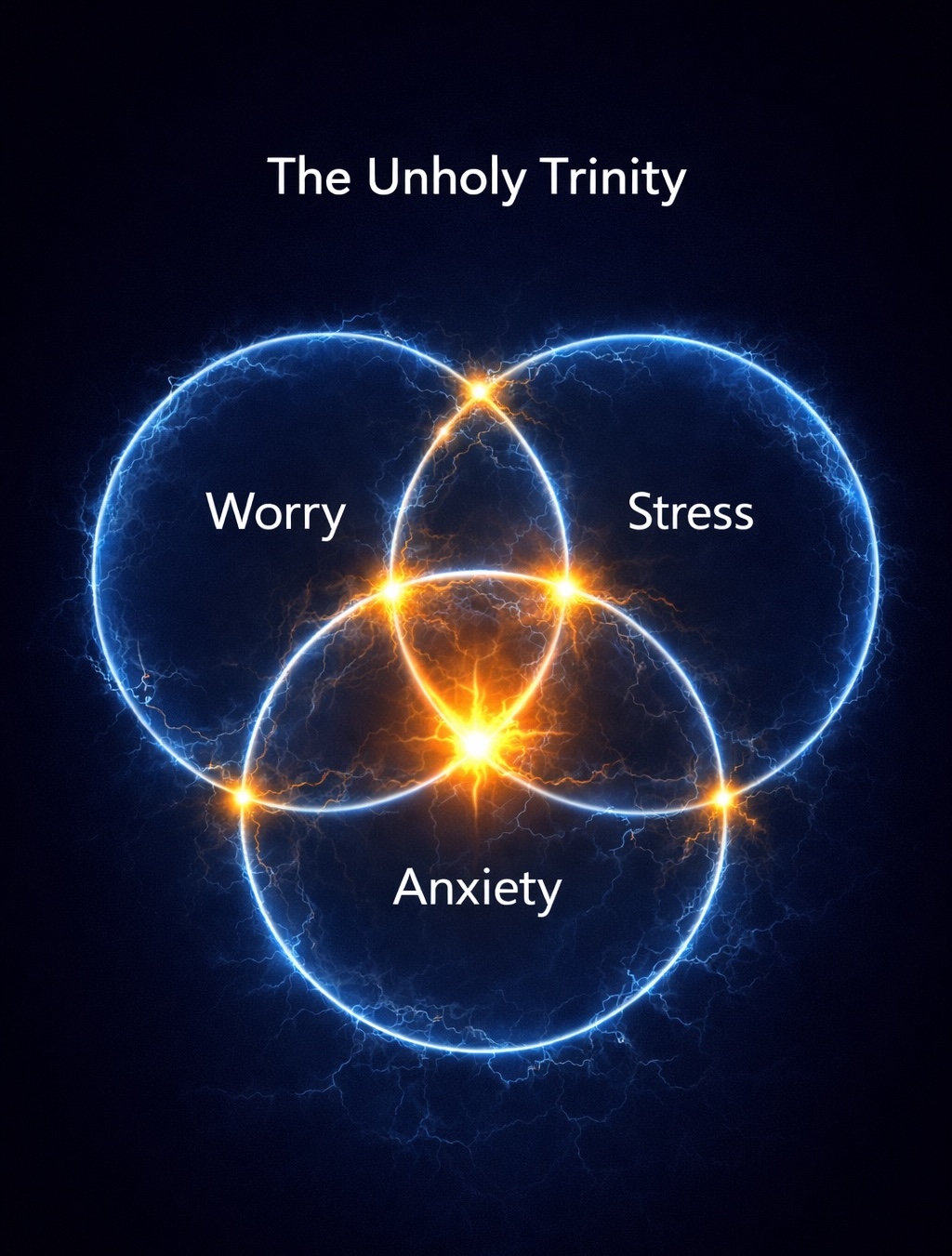
Meet the Unholy Trinity
We tend to use these three words interchangeably, but they are actually three very different beasts, and confusing them is costing you a lot.
Stress → Worry → Anxiety
Think of it this way: if stress and worry got married and had a child, they’d name it Anxiety. Understanding the difference isn’t just interesting; it’s the foundation for actually doing something about it.
Stress
Stress is physiological. It’s what’s happening inside your body; the hormonal cascade, the racing heart, the tension in your shoulders before a big pitch. Cortisol and adrenaline flood your system, your HPA axis (Core Stress Response System) fires up, and your body genuinely cannot tell the difference between a life-threatening situation and a difficult email.
In short bursts, that’s useful. Chronically? Your system starts breaking down.
Medical research estimates that up to 90% of illness and disease is stress-related.
Here’s where it gets personal: the Controller, the Perfectionist, and the Hyper-Achiever each experience stress physiology differently.
- The Controller feels it as hypervigilance, an urgent need to take charge. The body signal is actually about safety and capacity, not strategy.
- The Perfectionist experiences it as analysis paralysis and thinks “never quite good enough.” The nervous system is quietly waving a red flag that the standards you’re running are not legitimate.
- The Hyper-Achiever mistakes adrenaline for aliveness and calls it high performance. It feels the rush for the next win. The body is signaling it’s running on fumes, not fuel.
Worry
Worry is cognitive. It lives in your thoughts, not your body and it’s fear-based. It’s the “what if” spiral, the 2 am mental spreadsheet of everything that could go wrong.
According to the National Science Foundation, 80% of our thoughts are negative, and 95% of them are repetitive.
Read that again. Most of what your brain is rehearsing isn’t new information. It’s the same fear, on a loop, dressed up as productivity.
What If Your Anxiety Is Actually Data?
Anxiety
Anxiety is the emotional response that emerges when stress and worry combine, characterized by dread, foreboding, and constant threat-scanning. When anxiety takes over, relaxing feels impossible, calm feels suspicious, and rest feels dangerous.
This is why knowing the difference matters. Stress needs a physiological response. Worry needs a cognitive one. Treating them the same way, or worse, pushing through both, is what creates the perfect storm for chronic illness, burnout, and the kind of plateau no business strategy can break through.
The Business Bottom Line
You’ve built your success on being sharp, fast, and decisive. But here’s what the data actually shows: chronic stress degrades decision-making, narrows creativity, and erodes the relationships your business depends on. Your Inner Critic calls it “staying sharp.” Your body calls it something else entirely.
The goal isn’t to eliminate stress. It’s to learn to read it, so it stops “running you” from the background.
The good news? You don’t need a new strategy. You need a new skill, and here’s where to start.
Quick Practice: The Stress Decoder (2–5 minutes)
When you notice stress or worry creeping in, try this instead of pushing through it.
Step 1: Name it (30 seconds). Ask yourself: Is this stress, worry, or anxiety?
- Am I reacting to something real happening in my body right now? → Stress
- Am I spinning on a “what if” thought? → Worry
- Am I scanning for threats that aren’t here yet? → Anxiety
Just naming it shifts you from autopilot to awareness.
Step 2: Find the thought underneath (1–2 minutes). Write down or say out loud the exact thought that’s looping. Don’t clean it up. Then ask:
- Is this about something real and present or imagined and future?
- Is this a fact or a fear dressed up as a fact?
Step 3: Reframe the signal (1–2 minutes). Replace “something is wrong with me” with the truth. Say this to yourself instead.
“My nervous system is doing its job. This is cortisol talking, not reality.”
Then ask: “What would I tell a trusted friend who came to me with this exact thought?”
If you recognized yourself anywhere in the Unholy Trinity, that’s not a coincidence. Email me to book a complimentary discovery call, and we’ll map out exactly where stress, worry, and anxiety are capping your performance.

Calm and Centered Toolkit
I have created this anti-anxiety and anti-stress tool kit, proven by science, to help you reduce anxiety and stress. I guarantee you that if you implement some of these ideas and use these tools; you will navigate this uncertainty boat like a highly skilled Captain.